

British Motorcycle Electrical Systems: Solid State Regulators

From the factory, British motorbikes were fitted with a rectifier and either 1 or 2 Zener diodes. Because they consist of fragile electrical components that can dry up over time or fail from vibrations. You can replace the parts themselves, but the quality of replacement rectifiers and Zener diodes leaves a lot to be desired, so we recommend replacing them with solid state regulators.
This video includes:
-How to Identify if You Already Have a Regulator
-What Options are Available?
-Key Features
-Advantages and Disadvantages
We understand British bike electrical systems can be confusing. If you have any questions or would like recommendations regarding your setup, please call us prior to purchase. We do not accept returns on electrical items but are happy to help specify and troubleshoot your electrics within reason.

Check our entire catalog of electrical Triumph parts. It includes top brands such as Boyer Bransden, Lucas, Podtronics, Tri-Spark, Tympanium, Sparx and British Wiring.
Introduction: Rectifiers, Zener diodes, and regulators
From the factory, you’re vintage Triumph, Norton or BSA was fitted either 1 or 2 zener diodes. These items, while fairly crude, were mechanical means of accomplishing two goals: number one, converting AC current from your alternator to usable DC power to run lights and ignition and charge the battery; and number two, limiting the amount of DC power sent to the battery to prevent overcharging.
When the bike runs, the alternator puts out power to keep the bike running and charge the battery. The power is converted from AC to DC by the rectifier. When overcharging begins, the Zener diode shunts the current to ground and bleeds off excess voltage in the form of heat dissipation.
While this system works fine under normal conditions, both the rectifier and Zener diode consist of fragile electrical components that can dry up over time or fail from vibration. The quality of replacement rectifiers and Zener diodes leaves a lot to be desired, so we suggest replacing them with a solid-state regulator.
Replacing the OEM Lucas Zener diode and rectifier with a solid-state regulator is probably the most common modification you can make to your vintage British bike. As such, there are a lot of options available from multiple different companies, including Podtronics, Sparx, Boyer Bransden, Tympanium, Wassell, and Lucas.
Further, some options have a built-in capacitor that makes for easier starting and will allow points and some electronic ignitions to run without a battery.
How to identify what is already installed
Now, you may already have one of these installed on your bike and not even know it. Luckily, they’re easily identifiable.
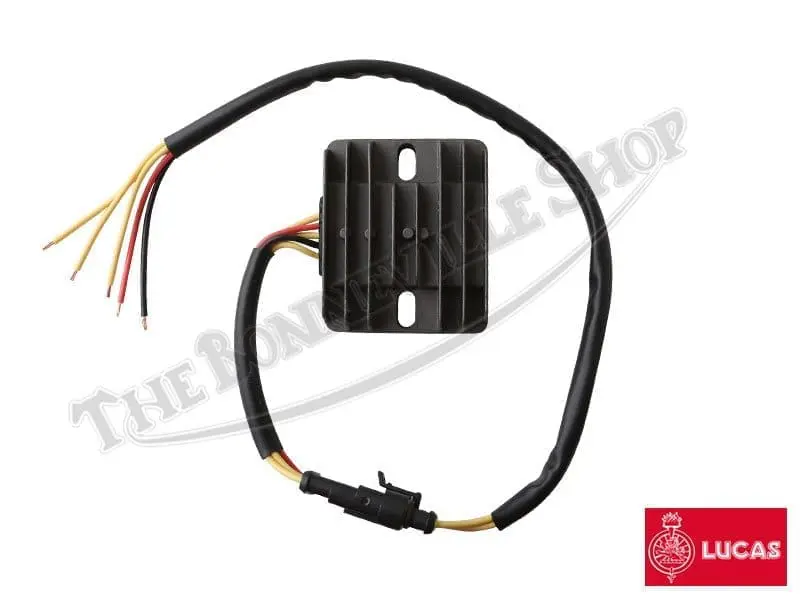
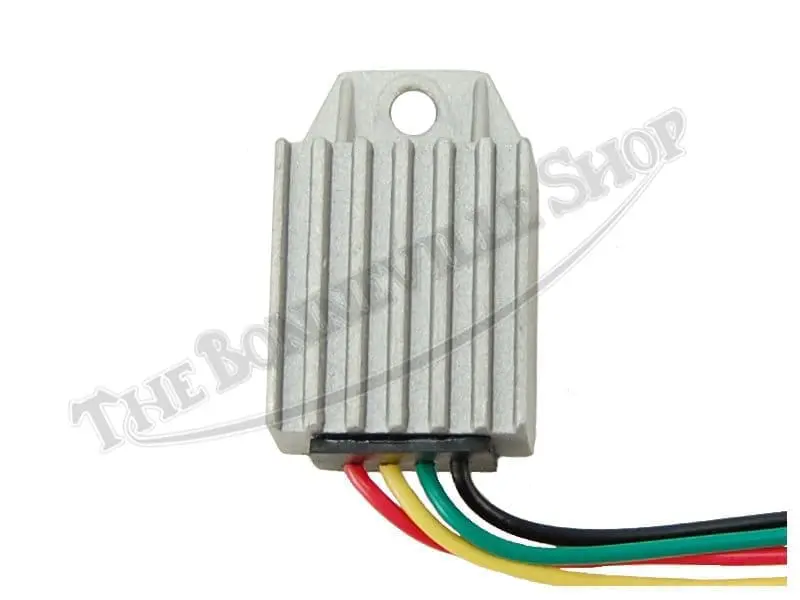
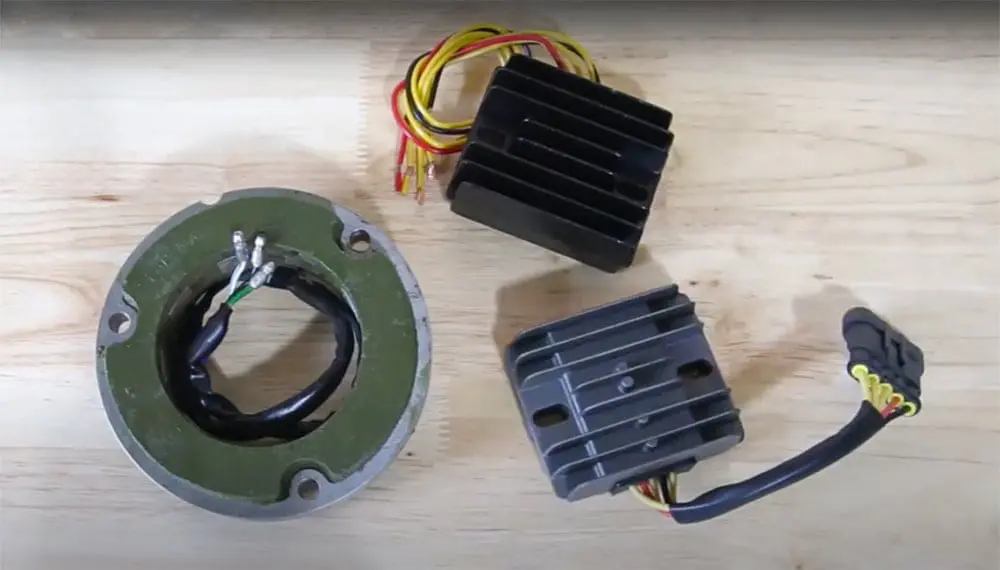
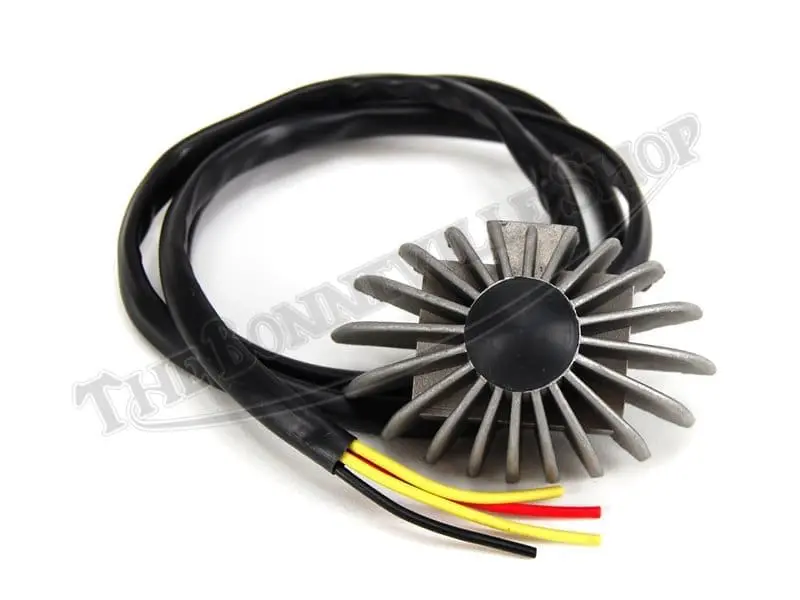
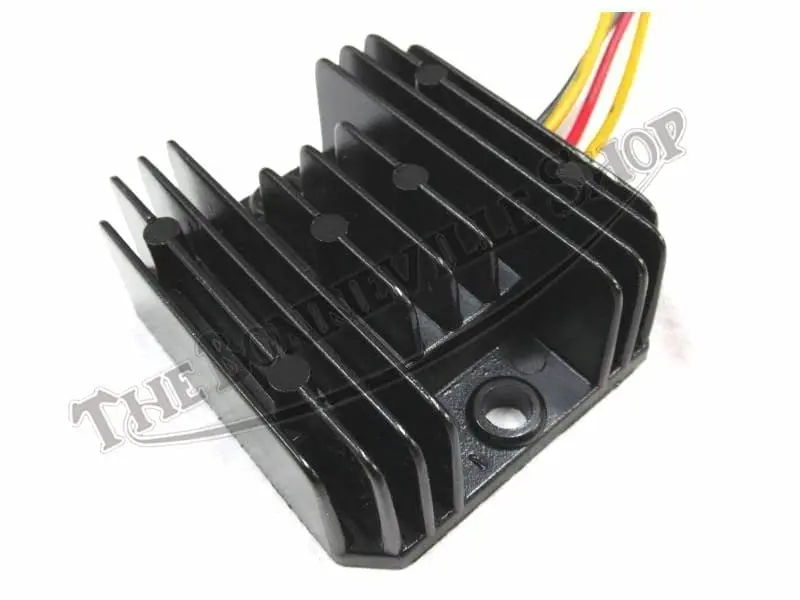
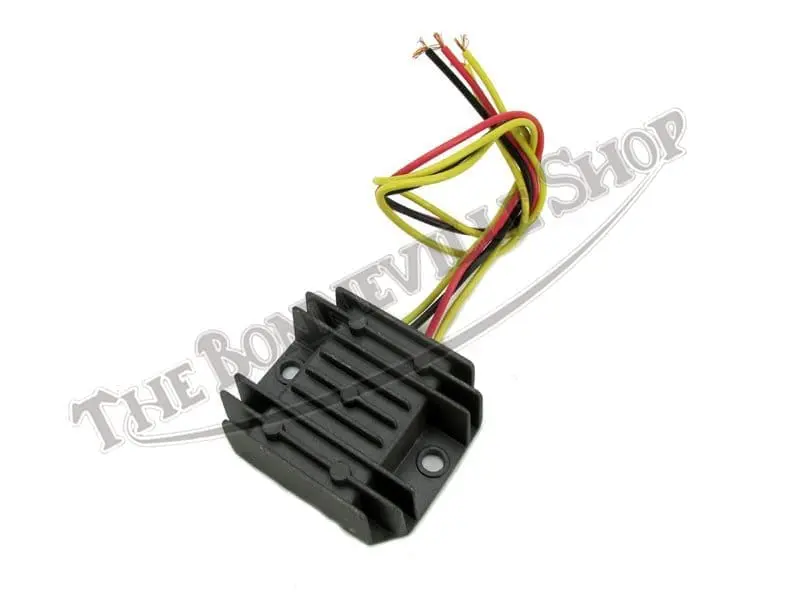
Most are a box about three inches by three inches square, usually with cooling fins integrated into the housing and four or five wires exiting them.
You may find one the size of a small brick labeled “Mity Max.” These are no longer offered, but were an early regulator option fitted to thousands, if not tens of thousands, of British bikes back in the 1980s and 1990s.
If you find a regulator already installed on your bike, great. You’ll still want to try to identify what model you have so you know its limits.
If you don’t find a regulator, chances are you’ll still have the rectifier and Zener diode—or diodes—fitted.
The rectifier is about one inch by one inch and consists of a series of small plates sandwiched on top of each other, with a common bolt running through them to ground. It’s usually located in the area under your seat.
The Zener diode is a small brass object located either under the seat or mounted to the front of the bike in a finned heat sink.
When replacing these with a solid-state regulator, you’ll first need to unhook both of them. The rectifier and Zener diodes don’t necessarily need to be removed from the bike entirely, but they do need to be unplugged from the electrical circuit.
You’ll also want to insulate these now-abandoned wire connections to prevent them from causing a short circuit.
Available regulator options
Okay, so you’ve decided to fit a solid-state regulator for increased reliability and peace of mind. Now, how do you know which one you should choose?
The best way to decide is to know what options are available, their key features, and the advantages or disadvantages of each of them.
So, the regulator options that we stock:
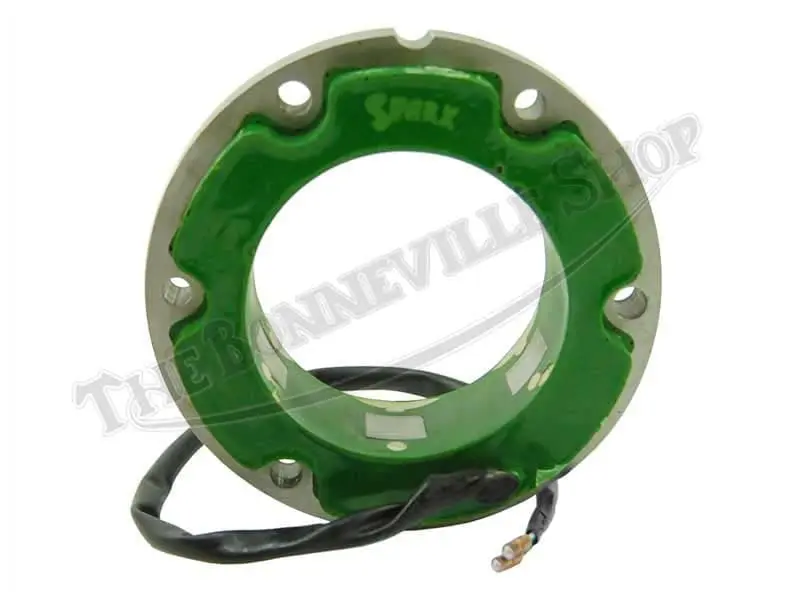
- TBS-0018. It’s a Sparx single-phase regulator in a Zener diode housing.
- TBS-3572, the Boyer Bransden Power Box with no light delay built in.
- TBS-3572A, the Boyer Power Box that has a light delay built in.
- TBS-4030, a Podtronics-brand single-phase, high-output regulator with a capacitor built in.
- TBS-4034, a Tympanium single-phase regulator.
- TBS-4034AT a Podtronics three-phase regulator.
- TBS-4034AW, a Lucas-brand three-phase regulator.
- TBS-4034P, a single-phase Podtronics regulator without a capacitor built in.
- TBS-4034W, a single-phase regulator from Wassell.
- TBS-4035, a single-phase, high-output regulator from Podtronics—the same as 4030, but without the capacitor built in.
- TBS-4036, a six-volt, positive-earth regulator for pre-unit dynamo models.
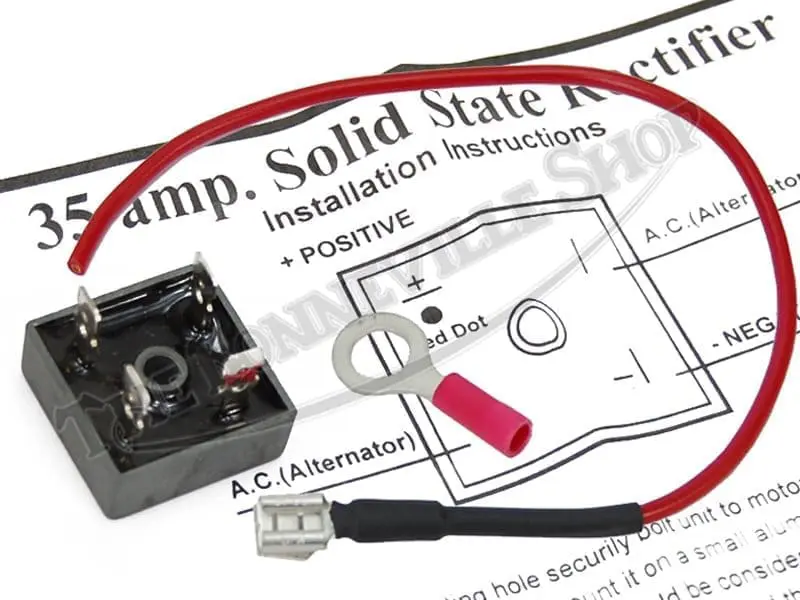
- 99-9882, which is a solid-state rectifier replacement.


Rectifier replacements and dynamo regulators
99-0982 is simply a replacement for the stock rectifier. While fitting one of these is a great solution if your rectifier fails, you’ll still be relying on your Zener diode to function correctly.
Next, we have TBS-4036. If you want to replace the Lucas MCR2 regulator on your dynamo-equipped pre-unit motorcycle, this is the regulator for you.
Now, keep in mind these are polarity-sensitive. So, if your bike is positive earth, as original, this regulator is just the ticket.
If your bike is wired negative earth, there is a negative-earth version of this regulator that we can order you, but we don’t generally keep it in stock.
Another bonus of this regulator is that it is small enough to fit inside the MCR2 enclosure, so it can be hidden to retain the original appearance of your motorcycle.
Identifying your alternator and stator
Now, let’s talk about options for alternator bikes.
As there were—and are—multiple alternator options available, you’ll need to know what yours has fitted before choosing your regulator.
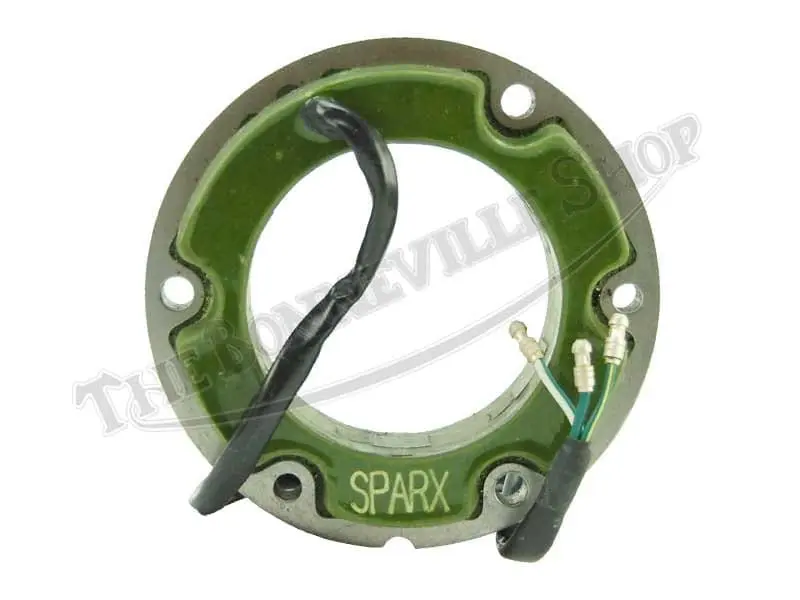
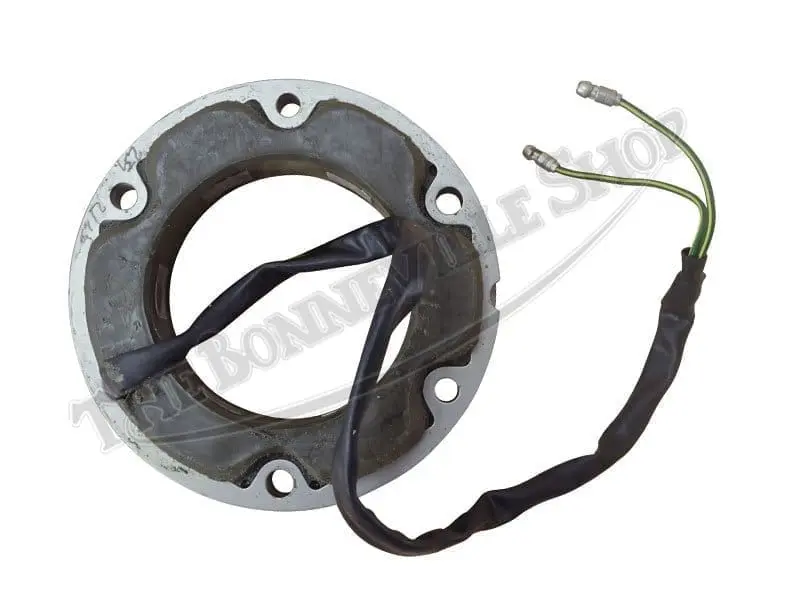
You may have a two-wire single-phase stator, a three-wire single-phase stator, or a three-wire three-phase stator fitted to your bike.
If you have a two-wire stator fitted, you know it’s single-phase, but it may either be a standard 10-amp stator or a high-output 15- or 16-amp stator.
To know for sure, you’ll want to look for markings on the stator itself. If you can’t find any markings, assume it’s high-output just to be safe, and select one of our high-output regulator options.
If you have a three-wire stator, it could either be single-phase or it could be three-phase. To know for sure, remove your stator and count how many pickup poles it has on the inside.
Six poles, and it’s going to be single-phase. If it has nine poles, it’s three-phase.
If it’s a single-phase stator, your bike may be wired as six-volt. By following the instructions included with the regulator you choose, you’ll be converting it from six-volt to 12-volt. You’ll need to complete the conversion by fitting 12-volt bulbs, horn, and battery to your motorcycle.
If you have a three-phase stator fitted, you’ll need to select one of our three-phase regulators.
Three-phase regulator options
There are two choices for three-phase regulators. We have one from Podtronics and one from Lucas.
Electrically speaking, they’re both about the same. Both will handle either the 10½- or 14½-amp Lucas, L.A.P., or Sparx three-phase stator outputs.
The Lucas-branded one, part number TBS-4034AW, also includes a quick-detach wiring harness with it. The Podtronics-branded one, part number TBS-4034AT, is slightly less expensive.
Sparx single-phase regulators
Now, TBS-0018 is a favorite of mine. It’s made by the Sparx company, and this regulator is built into a housing that looks like the Zener diode heat sink fitted to the front forks of Triumph bikes starting in 1968.
It’s rated for high-output use. It’s compatible with all of the single-phase stators we stock from Sparx, L.A.P. and Lucas.
The second Sparx-brand option we stock is part number TBS-0069. Also rated for high output use, it to is compatible with all of the single-phase stators we stock from Sparx, L.A.P., and Lucas.
Additionally, this unit has a built-in capacitor, electrically similar to the Lucas 2MC, for easier starting and, in some scenarios, a batteryless ignition.
Tympanium and Wassell regulators
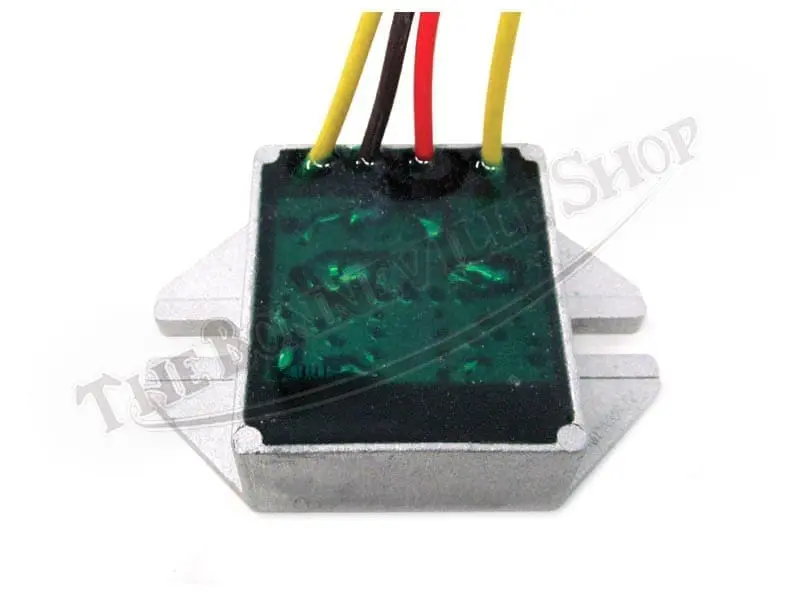
Next up is a Tympanium regulator, part number TBS-4034.
Much like the Mity Max regulator mentioned earlier, the Tympanium has been available since the 1980s, and it’s been fitted to thousands upon thousands of British bikes ever since.
It’s identifiable by the lack of cooling fins and a green or brown potting wax housing the electrical components.
Now, this is one of the least expensive options available, and as such, its uses are limited to bikes fitted with a 10-amp single-phase stator.
Another low-cost option is the Wassell-brand regulator, part number TBS-4034W.
Electrically speaking, it’s about identical to the Tympanium, so you’ll only want to use it with 10-amp stators.
Boyer Bransden Power Boxes
Now, on the other end of the pricing spectrum, we have the Boyer Power Boxes, part numbers TBS-3572 and TBS-3572A.
Both of these are designed specifically to allow you to run your Boyer Bransden electronic ignition without a battery, which is why they’re more expensive.
Now, keep in mind, if you do intend to run batteryless with an electronic ignition, you’ll need a top-performing alternator. We really recommend replacing both your stator and rotor when attempting to do so.
The Boyer Power Boxes are single-phase units rated at 180 watts, so we don’t recommend running them with 15- or 16-amp high-output stators, as they’re right at that threshold. It’s best to keep them paired with 10-amp stators, just to be safe.
TBS-3572A has an additional lighting-delay circuit built in. So, when the bike’s started, the lights are off. After the bike runs for a short time, the lights turn on automatically, removing the need for a separate light switch on custom bikes.
Podtronics single-phase regulators
Lastly, we have Podtronics single-phase regulators.
We offer three Podtronics options for single-phase charging systems.
TBS-4030 is our favorite and the best seller of the lot. This regulator will handle the output from any of our single-phase stator offerings—10-amp, 15-amp, and 16-amp—from Lucas, Sparx, and L.A.P.
It also has a capacitor built in for easier starting and to allow running batteryless with points ignitions.
We have had some luck in the past running bikes without a battery fitted with an electronic ignition using one of these regulators. However, the charging system must be in top condition.
Even then, we really don’t recommend it, as a battery makes for much easier starting and working system lights, and it also adds to the bike’s overall reliability.
TBS-4035 is essentially the same Podtronics regulator as TBS-4030, just without the built-in capacitor. It will handle all standard and high-output single-phase Lucas, L.A.P., and Sparx stators.
Lastly, we offer TBS-4034P from Podtronics. This regulator is suitable only with 10-amp stators, and it’s comparable to the Wassell and Tympanium regulators we featured earlier.
Voltage, polarity, and reliability
Aside from the polarity-sensitive regulators for dynamo-equipped bikes, all of the regulators we featured here are 12-volt only and can be installed either negative or positive earth.
Most six-volt alternator British bikes can be converted to 12-volt easily when fitting one of these regulators by joining two of the three wires together. Instructions for doing so are enclosed with all of the regulators.
From a reliability standpoint, we really can’t say any of these are better or worse than the others. All of them have proven extremely reliable in the field, and reported failures of any of them are few and far between.
Energy Transfer systems and closing
Now, one last point to note: none of the regulators we’ve discussed here are compatible with bikes fitted with the Energy Transfer, or ET, electrics—at least, not easily.
You’ll know your bike has an ET system fitted if your stator has more than three wires.
Bikes with ET electrics require replacement of the complete ignition system, including the ignition and the coils, as well as the alternator stator and alternator rotor. You can fit them with either a single-phase or three-phase charging system if you desire.
Table of Contents



Frequently Asked Questions
What does a solid-state regulator rectifier do on a classic British motorcycle?
A solid-state regulator rectifier converts the alternator’s alternating current (AC) into direct current (DC) and controls charging voltage. On a compatible classic Triumph, BSA, or Norton, a combined regulator rectifier replaces the original separate rectifier and Zener diode arrangement, bringing both functions into one unit.
Do I still need the Zener diode after installing a regulator rectifier?
No. A compatible combined regulator rectifier replaces both the original rectifier and the Zener diode or diodes. Follow the replacement unit’s instructions when disconnecting the original components. A rectifier-only replacement is different: it converts AC to DC but still needs a separate voltage-regulating component, such as the original Zener diode.
How do I choose the right regulator rectifier for my Triumph, BSA, or Norton?
Match the regulator rectifier to your motorcycle’s charging-system voltage, alternator phase, stator output, and earth polarity. You should also consider whether you need a built-in capacitor for a suitable batteryless installation. Identify the charging components currently fitted rather than relying only on the motorcycle’s model and year, since the correct regulator depends on the installed electrical system.
How can I tell whether my motorcycle alternator is single-phase or three-phase?
On the Lucas-type alternators covered in this guide, a two-wire stator is single-phase, but a three-wire stator can be either single-phase or three-phase. Check the stator’s identification markings first. For the stator types discussed in the article, six poles indicate single-phase construction, while nine poles indicate three-phase construction. Three wires alone do not mean you need a three-phase regulator rectifier.
What regulator rectifier do I need for a high-output alternator?
A high-output alternator requires a regulator rectifier rated for its output and designed for the correct phase. For the 15-amp and 16-amp single-phase stators covered in this guide, suitable options include Podtronics TBS-4030 and TBS-4035. The Tympanium TBS-4034 and Wassell TBS-4034W discussed in the article are intended for 10-amp single-phase stators, not these high-output applications.
Can I install a solid-state regulator rectifier on a positive-earth motorcycle?
Yes. The 12-volt alternator regulator rectifiers featured in this guide can be installed on either positive-earth or negative-earth motorcycles when connected according to their instructions. However, the dynamo regulators discussed in the article are polarity-sensitive. Always confirm your motorcycle’s earth polarity and the exact regulator’s specifications before installation.
Can a regulator rectifier convert my classic motorcycle from 6 volts to 12 volts?
Many classic British motorcycles with suitable three-wire, single-phase alternators can be converted from 6 volts to 12 volts when fitting an appropriate regulator rectifier. The conversion requires connecting the stator wires according to the regulator’s instructions and fitting compatible 12-volt equipment, including the battery, bulbs, and horn. Installing a 12-volt regulator alone does not complete the conversion.
Can I run a classic British motorcycle without a battery?
Some classic British motorcycles can run without a battery when the alternator, ignition, and regulator rectifier support batteryless operation. For example, the Podtronics TBS-4030 includes a capacitor and can support suitable points-ignition installations. However, batteryless operation depends on the complete electrical system. Keeping a battery generally makes starting easier and provides more dependable lighting and overall usability.
What regulator rectifier should I use for batteryless Boyer electronic ignition?
The Boyer Bransden Power Boxes covered in this guide are designed to support batteryless operation with compatible Boyer electronic ignition systems. They require an alternator in excellent condition, and we recommend replacing both the stator and rotor when building this type of system. For the 180-watt single-phase Power Boxes discussed in the article, we recommend a 10-amp stator rather than a 15-amp or 16-amp high-output stator.
What is the difference between Podtronics TBS-4030 and TBS-4035?
The main difference is the built-in capacitor. Podtronics TBS-4030 includes a capacitor to support easier starting and suitable batteryless points-ignition applications, while TBS-4035 does not. Both models handle the standard and high-output single-phase Lucas, Sparx, and L.A.P. stators covered in this guide, including 10-amp, 15-amp, and 16-amp versions.
Can I use an alternator regulator rectifier on a Lucas dynamo charging system?
No. A Lucas dynamo charging system needs a regulator designed for a dynamo, not an alternator regulator rectifier. For a suitable 6-volt, positive-earth application originally using a Lucas MCR2 regulator, TBS-4036 is a solid-state replacement option. Because dynamo regulators are polarity-sensitive, a negative-earth motorcycle requires the appropriate negative-earth version.
Will a solid-state regulator rectifier work with an Energy Transfer ignition system?
The regulator rectifiers covered in this guide are not direct replacements for components in an original Energy Transfer, or ET, electrical system. Converting an ET-equipped motorcycle to a conventional charging and ignition arrangement requires a broader conversion, including the ignition, ignition coils, alternator stator, and rotor. Identify your existing electrical system before ordering a replacement regulator rectifier.