

An Overview of the Smith’s BG5330 Speedometer Drive Units
By Dave Porter, Technical and Customer Support at The Bonneville Shop
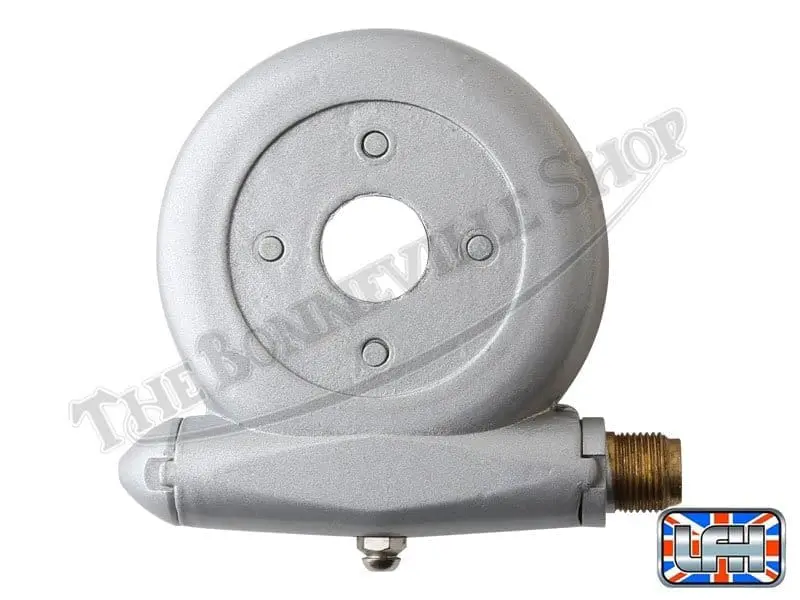
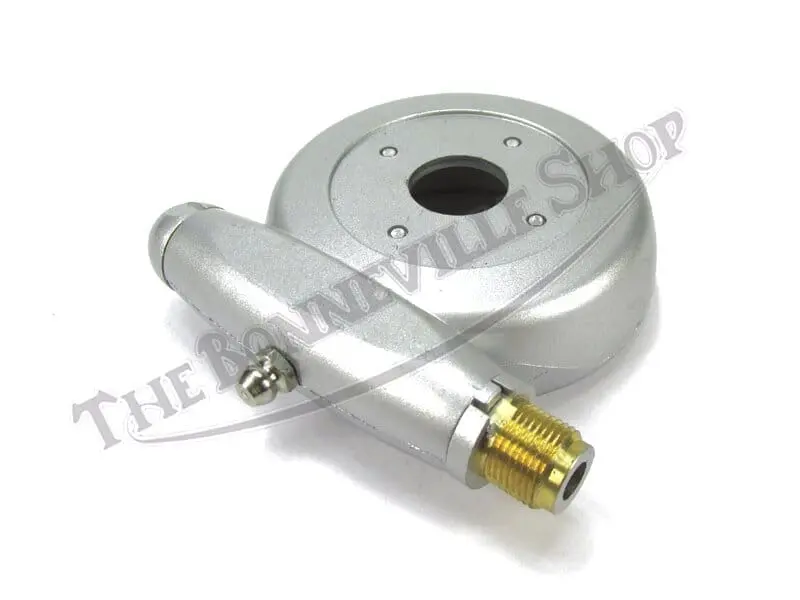
Most vintage British motorcycles from the mid-1960s into the 1980s were originally fitted with Smith’s or Veglia magnetic speedometers which are driven by a gearbox unit mounted to the rear hub. A fixed drive ring on the rear wheel hub rotates with the wheel which in turn, rotates the gearbox inner driving gear. As the driving gear engages with the internal driven gear, the direction of the cable receiver is reversed, with the cable serving as the nexus between the speedometer drive gearbox and the instrument.
The majority of most common BSA, Norton, and Triumph twin-cylinder models from 1966-onward are fitted with this type of speedometer drive gearbox, the Smith’s BG5330 series (although the early unit C-range Triumph 350cc and 500cc models were the exception, as they were fitted with rear wheel-driven speedometer drives from 1959-on). Early 1960s models from AJS, Matchless, and Norton also employed rear wheel-driven speedometer drives. I’ll focus on the most commonly seen BG5330 models in this blog.
Several factors are to be considered when replacing a faulty original (or completely missing) speedometer drive unit during a restoration (or refurbishment):
Drive ratio
The BG5330 speedometer drives were available in 1.25:1 (15/12), 2:1, 21/10, or 19/20. The most commonly used ratios are 1.25:1 and 2:1. It is important to determine the ratio calibration of the speedometer that is to be used with a given speedometer drive unit to ensure accurate speed and odometer readings. The two components must be paired together.
Axle hole size
The most common sizes are manufactured to fit 5/8”, 11/16”, and 3/4” axles, or spindles.
Reversing or non-reversing operation
The majority of BG5330 units specified for use on BSA, Norton, and Triumph models are reversing operation.
Rear hub orientation
Most all BG5330 units are fitted to the right, or non-drive side of the hub. The exceptions to this are the 1975 Triumph T160 and Norton Commando MK3 models, which have the speedometer drive fitted to the left side of the hub.
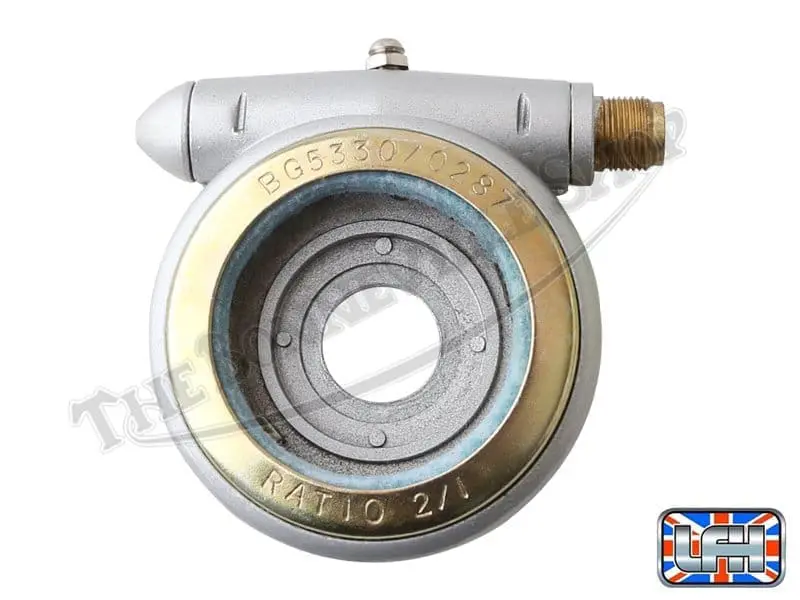
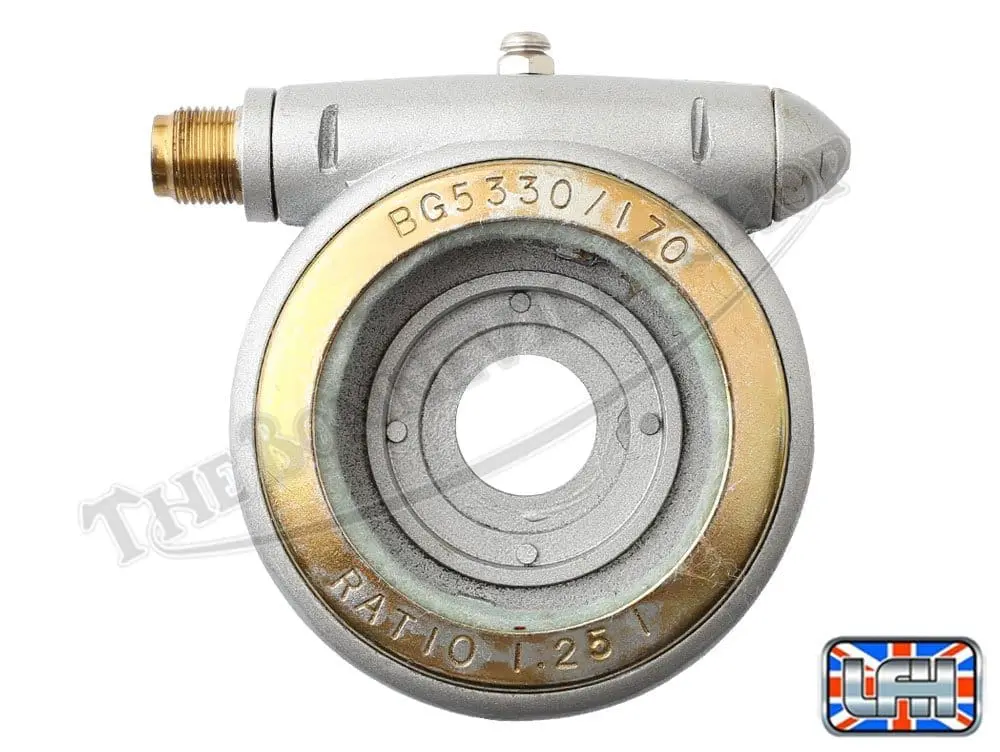
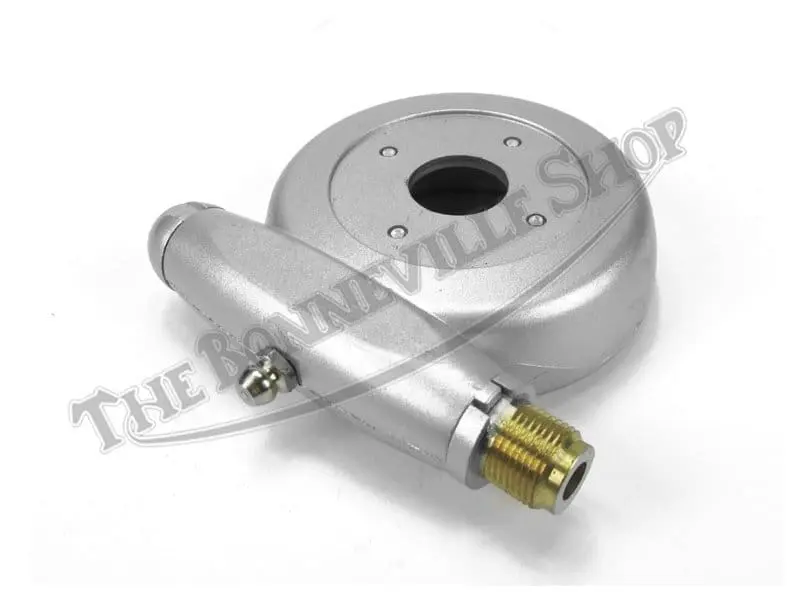
Since the various BG5330 units share the same castings, it is critical that the minor details be determined prior to fitment on the motorcycle. A measurement of the axle hole and visual inspection of the gold-colored felt seal retaining ring is recommended to assure correct fitment and calibration of the speedometer gearbox. The identifiers are stamped into the gold retaining ring.

Now, let’s take a look at the most common fitment applications:
BG5330/164 Fits1971-1974 Triumph, BSA 650, 750 twins and triples with conical hubs and 5/8” rear axle. Also used on the 1976-1978 disc brake hubs. 1.25:1 (15/12) ratio is often paired with Smith’s SSM 5007/00 and SSM 4003/02 150 MPH black-face speedometers. The Triumph part number is 60-3213. BSA identified the same unit as 19-9225.
BG5330/168 Fits late 1967-1970 Triumph 650, 750 twins and triples, as well as the BSA A75 triple with spool hub and 3/4” rear axle. 1.25:1 (15/12) ratio is often paired with Smith’s SSM 5001/06 and SSM 5007/00 150 MPH grey or black-face speedometers. The Triumph part number is 60- 0637. BSA identified the same unit as 19-9221.
BG5330/171 Fits late 1967-1970 BSA twins and 1968-1974 Norton Commando models with 11/16” rear axle. 1.25:1 (15/12) ratio is often paired with Smith’s SSM 3001/02, SSM 3001/09, SSM 5001/05, and SSM 5007/00 150 MPH grey or black-face speedometers. The BSA part number is 19-9217, while Norton used the part number 06-0627.
BG5330/287 Fits 1959-1974 Triumph 500 twins, as well as the 1966-early 1967 Triumph 650 models with spool hub and 3/4” rear axle. 2:1 ratio is often paired with Smith’s SSM 5001/00, SSM 5002/00, SSM 5007/02 120 MPH grey or black-face speedometers. Early unit-construction 350 and 500 twins through 1963 were equipped with Smith’s Chronometric speedometers calibrated for 2:1 drive gearboxes. The Triumph part number is 60-0373.
BG5330/170 Fits 1975 Triumph T160 and Norton Commando MK3 models, with disc brake hubs, 5/8” rear axle and left-side mounting. 1.25:1 (15/12) ratio is paired with Smith’s SSM 4004/00 150 MPH black-face speedometer. The Triumph part number is 60-4403, while Norton used the part number 06-5540.
The Bonneville Shop offers reproductions of the Smith’s BG5330 series speedometer drive gearboxes from two different suppliers, LF Harris and EMGO. The quality and finish of the two reproduction brands is nearly identical, with the EMGO units priced slightly lower. I hope this blog helps answer any questions that may arise when attempting to source the correct speedometer drive gearbox for your application.

Smith’s BG5330 Speedometer Drive Units FAQ
What is a Smiths BG5330 speedometer drive and how does it work?
The Smiths BG5330 is the gearbox on the rear wheel hub that drives the speedometer on most 1966-and-later BSA, Norton and Triumph twins and triples. A drive ring on the hub turns with the wheel and spins the gearbox’s inner driving gear. That gear meshes with a driven gear that turns the speedometer cable, and the cable turns the magnetic speedometer. Smiths was the main instrument supplier to the British motorcycle industry for decades; Hemmings has a short history of Smiths Industries, and Wikipedia explains how mechanical speedometers work.
Which motorcycles use the BG5330 speedometer drive?
Most common BSA, Norton and Triumph twins from 1966 onward use a BG5330-series drive, along with the Triumph Trident and BSA Rocket 3 triples. The early Triumph unit-construction 350cc and 500cc C-range models are the exception. The five most common versions are the BG5330/164, /168, /171, /287 and /170. Each one is matched to a specific hub, axle size and speedometer.
How do I identify which BG5330 speedometer drive I have?
The model number is stamped into the gold-colored felt seal retaining ring on the gearbox. All BG5330 units share the same casting, so the stamping is the most reliable way to tell them apart. Also measure the axle hole: the common sizes are 5/8″, 11/16″ and 3/4″. Most units are reversing (they reverse the cable’s direction of rotation) and mount on the right-hand, non-drive side of the hub. If the stamping is worn off, read the ratio from your speedometer face and match the axle size to the chart in this article.
What is the difference between a 1.25:1 (15/12) and a 2:1 speedometer drive?
The ratio sets how many times the speedometer cable turns for each turn of the rear wheel. The 1.25:1 (15/12) ratio is used on most 1967–1978 Triumph, BSA and Norton models with 150 mph speedometers. The 2:1 ratio is used mostly on Triumph 500 twins and 1966–early 1967 Triumph 650s with 120 mph speedometers. BG5330 drives were also made in less common 21/10 and 19/20 ratios. The drive and the speedometer must be calibrated as a pair. For example, the 150 mph black-face SSM 5007/00 replica needs a 1.25:1 drive, and the 120 mph grey-face SSM 5001/00 replica needs a 2:1 drive.
What happens if my speedometer and speedometer drive ratios don’t match?
Both the speedometer and the odometer will read wrong. A 2:1 drive paired with a speedometer calibrated for 1.25:1 will read high, and the reverse pairing will read low. Smiths speedometers have a turns-per-mile (TPM) number printed on the dial. The Triumph Club of New Zealand’s guide to Smiths gauges shows how to check that number against your wheel and drive. If you’re replacing both parts, shop our Triumph instruments, BSA instruments or Norton instruments so you get a matched pair.
Which speedometer drive fits a 1971–1974 Triumph or BSA 650/750 with a conical hub?
The BG5330/164 (Triumph 60-3213, BSA 19-9225) fits 1971–1974 Triumph and BSA 650 and 750 twins and triples with the conical hub and 5/8″ rear axle. It also fits the 1976–1978 disc brake hubs. It uses the 1.25:1 (15/12) ratio and is usually paired with the Smiths SSM 5007/00 or SSM 4003/02 150 mph black-face speedometer. We stock the LF Harris BG5330/164 and the EMGO BG5330/164.
Which speedometer drive fits a 1967–1970 Triumph 650, Trident or BSA Rocket 3?
The BG5330/168 (Triumph 60-0637, BSA 19-9221) fits late 1967–1970 Triumph 650 and 750 twins and triples, and the BSA A75 Rocket 3, with the spool hub and 3/4″ rear axle. It uses the 1.25:1 (15/12) ratio with Smiths SSM 5001/06 or SSM 5007/00 150 mph grey- or black-face speedometers, such as our grey-face 150 mph speedometer replica. Choose the LF Harris BG5330/168 or the EMGO BG5330/168.
Which speedometer drive fits a Norton Commando?
On 1968–1974 Norton Commandos, use the BG5330/171 (Norton 06-0627, BSA 19-9217). It has an 11/16″ axle bore and a 1.25:1 ratio. The same unit also fits late 1967–1970 BSA twins. The 1975 Commando MK3 has a different hub and needs the left-side BG5330/170 (Norton 06-5540). Both are listed under Norton instruments. For background on model years, see the Norton Commando entry on Wikipedia.
Which speedometer drive fits a Triumph T100, TR6 or T120 with a 2:1 speedometer?
The BG5330/287 (Triumph 60-0373) is the 2:1 drive for Triumph 500 twins and 1966–early 1967 Triumph 650 TR6 and T120 models with the spool hub and 3/4″ rear axle. It pairs with 120 mph Smiths speedometers such as the SSM 5001/00, SSM 5002/00 and SSM 5007/02, including our black-face 120 mph SSM 5007/02 replica. Choose the LF Harris BG5330/287 or the EMGO BG5330/287.
Why do the Triumph T160 and Norton Commando MK3 use a left-side speedometer drive?
The 1975 Triumph T160 Trident and Norton Commando MK3 have a rear disc brake hub that puts the speedometer drive on the left side of the wheel. They need the left-side BG5330/170 (Triumph 60-4403, Norton 06-5540), which has a 5/8″ axle bore and a 1.25:1 ratio and pairs with the Smiths SSM 4004/00 150 mph speedometer. A right-side unit will not fit. Shop the left-side BG5330/170 speedometer drive, or read more about the T160 in Wikipedia’s Trident and Rocket 3 history. Late 1978.5–1982 Triumph 750s with Veglia instruments use a different drive-side gearbox, the Veglia speedometer drive 60-7091.
Do I need a new speedometer cable when I replace the speedometer drive?
Not always, but check the cable whenever the drive is off. The cable threads into the gearbox at one end and connects to the speedometer at the other, so a kinked, dry or worn inner cable can cause needle bounce or a dead speedometer even with a new drive. Cable length depends on the model and where the speedometer is mounted. Find the correct cable in our Triumph cables, BSA cables and Norton cables sections, and see our guide to cables for routing tips.
What is the difference between LF Harris and EMGO BG5330 speedometer drives?
Both are quality reproductions of the original Smiths BG5330 gearboxes, and their fit and finish are nearly identical. The main difference is price: the EMGO units cost a little less. Browse the full ranges on our LF Harris and EMGO brand pages. If you’re unsure which unit fits your bike, contact our tech support team or call 720-570-7884, Monday–Friday, 9–5 MT.