

By Dave Porter, Technical and Customer Support at The Bonneville Shop
Lucas Console Switchgear Guide
The Back Story
During the late 1960s, the BSA Group was busy developing the next generation of Triumph and BSA motorcycles at a leased 17th-century mansion in Warwickshire, known as Umberslade Hall. Situated nearly equidistant from Redditch, Small Heath, and Meriden, the research and development facility was the epicenter for the design teams to update both ranges to the modern specifications needed to compete favorably with the already imposing Japanese machines of the period.
Many of the interesting prototypes from Umberslade never saw production, but the most famous of all of them was the new “Oil in Frame” Triumph and BSA 650 models. After production delays doomed the introduction of the new, redesigned Triumph models, they finally landed in dealership showrooms in the spring of 1971. New frames, forks, wheels, airboxes, sheet metal, and countless other updates were present on the new 1971 models, including the introduction of the new Lucas handlebar switch consoles, which also debuted on the BSA B25 and B50 street singles, Triumph T100 models, and the BSA and Triumph triples. Norton Commando models also were fitted with the new switchgear.
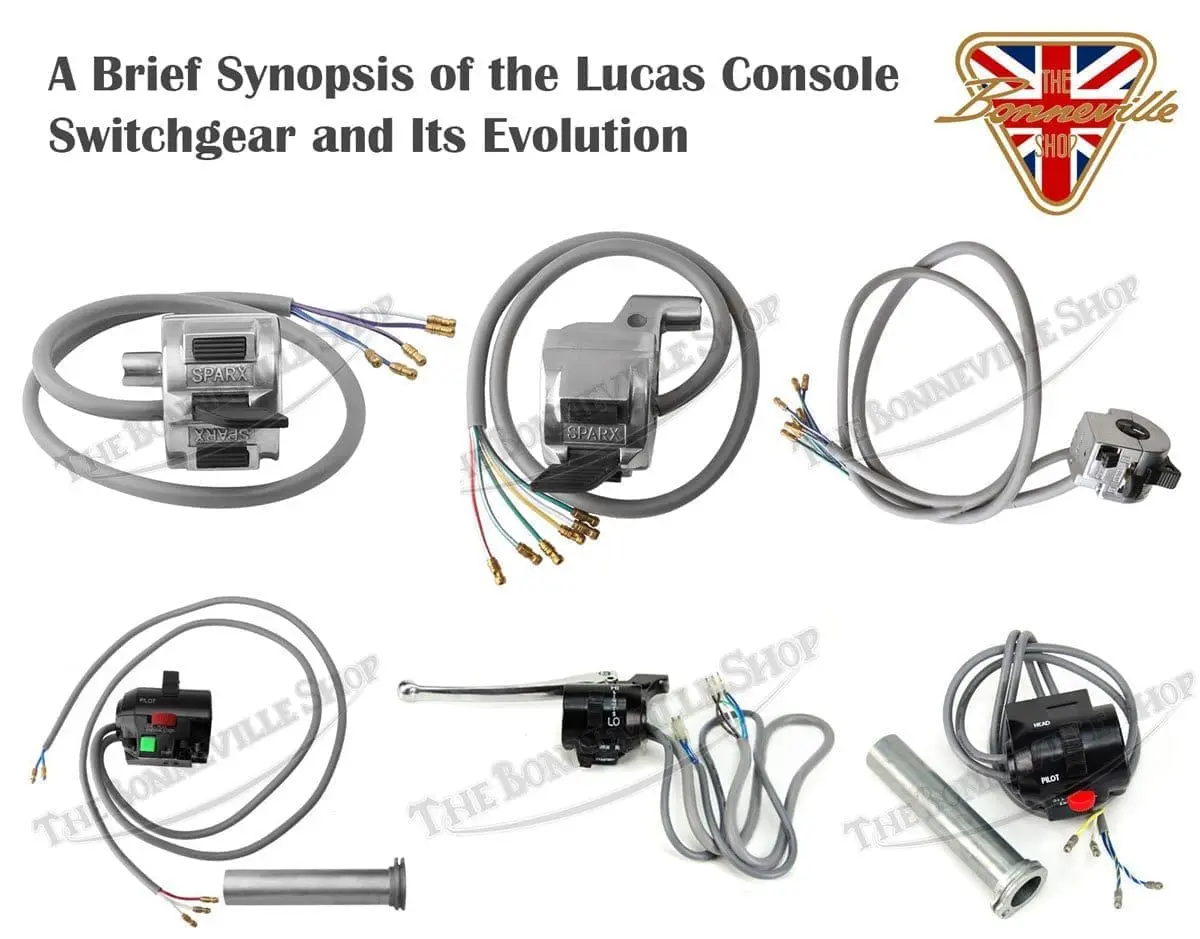
With the advent of directionals, and an eventual electric starter, the switchgear consoles evolved over the years, as did the motorcycles. The following section chronicles the evolution of the Lucas console switchgear.
“New frames, forks, wheels, airboxes, sheet metal, and countless other updates were present on the new 1971 models, including the introduction of the new Lucas handlebar switch consoles”
First Generation Lucas Console Switchgear – 39595 169SA
- The first generation of Lucas console switchgear used the 169SA body and first appeared for the 1971 model year. The 39595 high/low/horn switch was generally used as the left switch, while the identical 39596 controlled the directionals and had a “kill” button. These switches were interchangeable, and often were swapped from left to right, and vice versa, depending on the rider’s preferences. Drum brake models from BSA, Triumph, and Norton used the 169SA-bodied switches through the 1972 model year production. The 39595 switch can be identified by the blue wires, whereas the 39596 switch will have green wires, and also include the mysterious white/red wire that is not shown in the wiring diagram and seems to go nowhere. The intent was for an electric starter to be fitted on the machines at some point, so a power lead was fitted to the 54033667 switch-half circuit board, but the lead was not connected to anything in the wiring harness, and the pushbutton for the starter had no function.
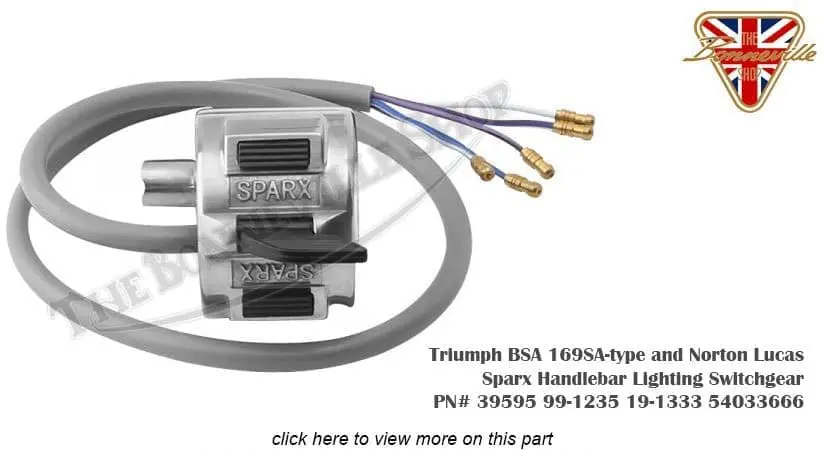
39596 169SA
“These switches (39595 & 39596) were interchangeable, and often were swapped from left to right, and vice versa, depending on the rider’s preferences.”
- When the front disc brake debuted for the 1973 model year, the 169SA switch body remained, but with a revised handlebar arrangement. The right-hand switch now operated the high/low beam and horn functions, while a brake switch was incorporated into the switchgear on the Triumphs. The switch-half was assigned the part number of 54033751 and was used on the TR7, T140, and T150 models through the 1974 model year. The 39596 switchgear was used on the left-hand side and operated the directionals and the kill button. Norton Commando models used a remote brake switch, so the 39951 right-hand switch gear was essentially the same as the original 39596, but with a longer paddle operating the directionals. The 39949 high/low beam and horn switchgear, as used on the left side on Nortons also used a longer paddle to operate the lighting circuit. While the 169SA switches were used on different motorcycles in differing iterations, they were rebuildable, which was good, as they were not waterproof, and the kill-button contacts are prone to corrosion, causing an electrical troubleshooting nightmare for riders to this day.
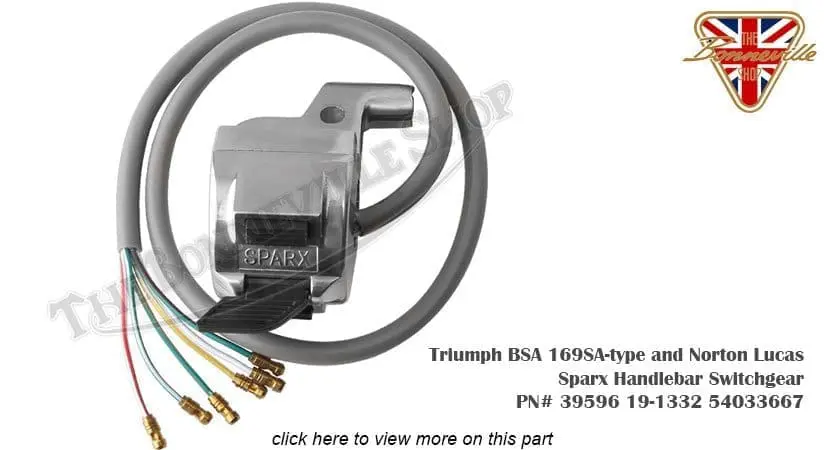
“While the 169SA switches were used on different motorcycles in differing iterations, they were rebuildable, which was good, as they were not waterproof, and the kill-button contacts are prone to corrosion, causing an electrical troubleshooting nightmare for riders to this day.”
30707 181SA and 35317 187SA
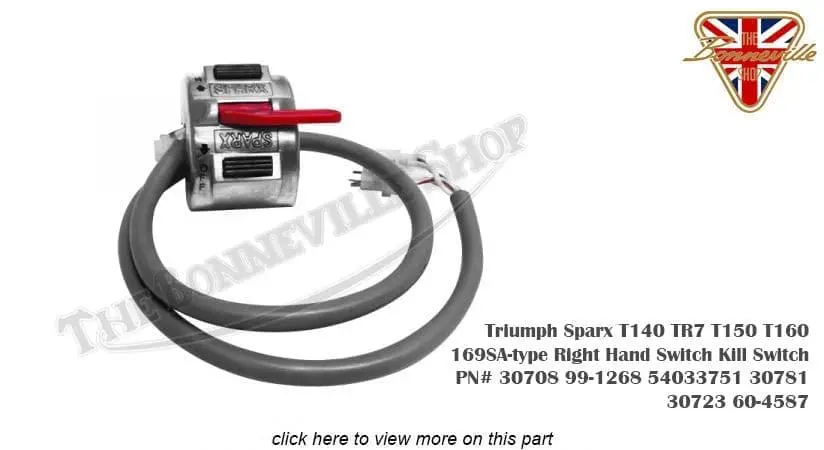
- The 1975 model year included the new Triumph T160, built at Small Heath, while the Meriden works was in upheaval in the aftermath of the strike. As a result, there was no real production of Triumph twins for the 1975 model year. Lucas, however, was ready to supply the new 181SA switchgear for the T160 models. The new left-hand 30707 switchgear was now a horizontally-split “clamshell” type that provided better resistance to the elements and operated the lighting, directionals, and horn circuits. The improved 30707 was also used on the TR7 and T140 models through the early 1978 models, as was the new 30723, (also referred to as 30708 and 30781) right-hand console, which was a revised version of the earlier 169SA-bodied switchgear, with a prominent long red paddle controlling engine “run” and “off”, and finally a functioning push button for the new electric starter used on the T160 models.
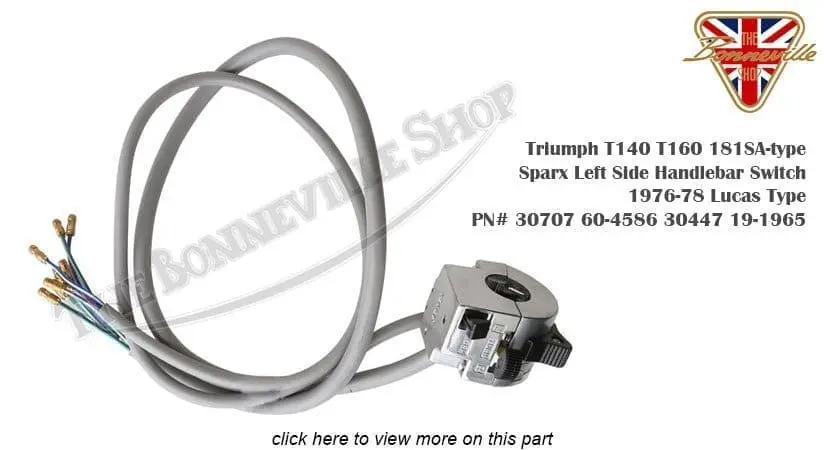
“The improved 30707 was also used on the TR7 and T140 models through the early 1978 models … and finally a functioning push button for the new electric starter used on the T160 models.”
35317 and 35316 – 187SA
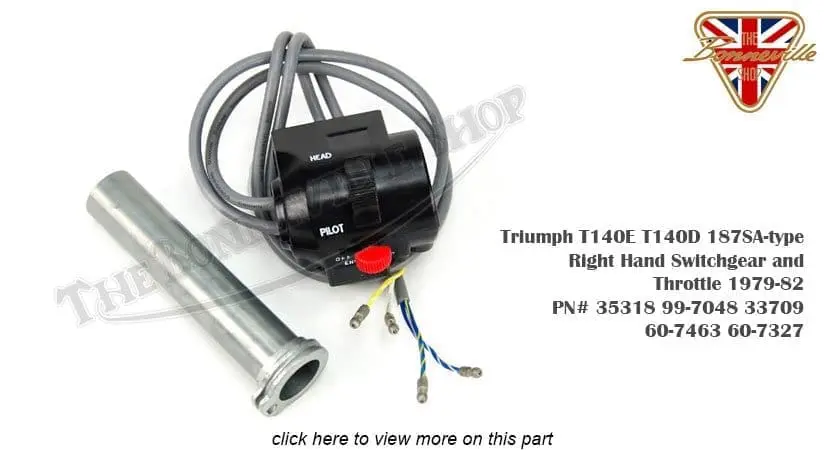
- The electric-start Norton Commando MK3 models featured a new sexy 187SA-bodied black-finished Lucas 35317 right-hand switch gear that incorporated a main/pilot headlight circuit, engine “run” and “stop” toggle switch, and of course, the electric start button. This switchgear was also used on the electric-start Triumph T140ES models from 1981-1982. The left-hand counterpart to the 35317 was the 35316 switch gear, which controlled the high/low beam, horn, and directionals. The 1978.5-1982 Triumph T140D, T140E, and TR7 models also used the 35316 left-hand switchgear, paired with the right-hand 35318 (33709) switchgear on the kickstart-only models.
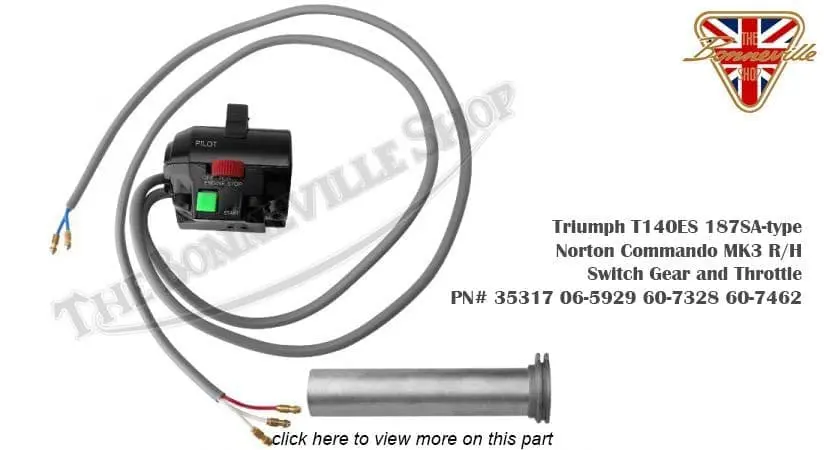
“The electric-start Norton Commando MK3 models featured a new sexy 187SA-bodied black-finished Lucas 35317 right-hand switch gear.”
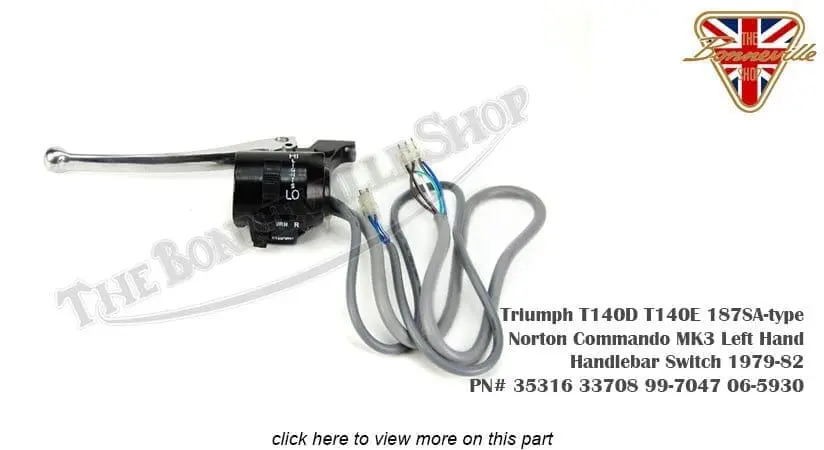
“The 1978.5-1982 Triumph T140D, T140E, and TR7 models also used the 35316 left-hand switchgear, paired with the right-hand 35318 (33709) switchgear on the kickstart-only models.”
35318 Right-Hand – 187SA
- With the availability of “new-old-stock” and even good used Lucas console switchgears consoles dwindling, Sparx has been supplying the market with reproduction Lucas-type switch consoles for many years, and we have found them to be of good quality and a relatively inexpensive option for restoring handlebar switch functionality on the 1970s models of BSA, Norton, and Triumph motorcycles. If you have an original Lucas 169SA console switchgear that has survived the past decades, we can supply the rebuild kits for the various iterations.

Lucas Console Switchgear FAQs
1. What is Lucas console switchgear?
Lucas console switchgear is the handlebar switch housing that controls the lights, horn, turn signals, kill switch and, on later bikes, the electric starter. It first appeared in 1971 on the oil-in-frame Triumph and BSA 650s, the BSA B25/B50, the Triumph T100, the triples and the Norton Commando. These bikes were designed at the BSA Group’s Umberslade Hall research center, and the switches were made by Lucas Industries of Birmingham
Which Lucas switchgear fits my Triumph, BSA or Norton?
It depends on the model year:
1971–72: 169SA bodies, 39595 and 39596.
1973–74 Triumph disc-brake models: 169SA with a built-in brake switch (54033751).
1975 to early 1978 Triumph: 181SA 30707 on the left, paired with the 30723/30708 on the right.
1975 Norton Commando MK3: 187SA 35317 and 35316.
Mid-1978 to 1982 Triumph T140D, T140E and TR7: 35316 on the left with 35318 (33709) on the right.
Our switches collection has every version listed here: https://thebonnevilleshop.com/switches/
What is the difference between Lucas 39595 and 39596 switches?
The 39595 controls the high beam, low beam and horn. It has blue wires and usually goes on the left. The 39596 controls the turn signals and the engine kill button. It has green wires and usually goes on the right on 1971–72 bikes. You can also buy the matched pair as a set
Can I swap my 169SA switches from left to right?
Yes. On 1971–72 bikes the 39595 and 39596 use the same 169SA body, so riders often switch them between sides to suit their preference. From 1973 on, disc-brake Triumphs had a brake switch built into the right-hand console, so swapping sides no longer works the same way.
What is the white/red wire on my 1971–72 Lucas switch for?
Lucas expected an electric starter to be added later, so it ran a power lead to the 39596 circuit board. That lead doesn’t connect to anything in the 1971–72 wiring harness, and the starter button does nothing. Leave it insulated. It isn’t a fault.
Why do my Lucas handlebar switches keep failing?
169SA switches are not waterproof. The kill-button contacts in particular corrode, which causes intermittent misfires, no-start problems and dead horns or lights. Cleaning the contacts helps for a while, but worn or corroded internal parts are best replaced with a rebuild kit or a new console. You’ll find more troubleshooting parts in our Triumph electrical and Norton electrical sections.
Can I rebuild original Lucas 169SA switches?
Yes, if the housings are in good shape. Genuine Lucas kits come with stainless internal parts and new paddles (the arrow-shaped levers):
1971–72 twins: the 169SA/A and the 169SA/B, with short paddles. The /B has one black and one red paddle.
1973–78 bikes: the 169SA/C and the 169SA/D, with long paddles.
All of these kits are listed in our Lucas electrical section.
Are Sparx reproduction switches as good as original Lucas?
Original new-old-stock and good used Lucas switches are getting hard to find. Sparx reproductions are a good-quality, lower-cost way to get working handlebar switches back on 1970s BSA, Norton and Triumph motorcycles. Our technical team stands behind them.
What is the difference between 169SA, 181SA and 187SA switch bodies?
169SA (1971 on): the original design, which can be rebuilt but isn’t waterproof.
181SA (1975 on, starting with the T160): a horizontally split “clamshell” body that holds up better against weather.
187SA (Norton MK3 and later T140 models): a black-finished body that adds main/pilot lighting, a run/stop toggle and an electric start button.
How is Norton Commando switchgear different from Triumph’s?
Nortons used a separate brake switch. The 1973-on Commando consoles (39951 on the right, 39949 on the left) are basically 169SA switches with longer paddles. The 1975 electric-start MK3 used 187SA consoles: the 35317 right-hand switch with throttle and the 35316 left-hand switch.
What switchgear does the Triumph T160 Trident use?
The 1975 T160 was the first Triumph triple with an electric starter. It used the 181SA 30707 left-hand console and the 30708/30723 right-hand console. The right-hand console has a long red run/off paddle and a working start button, and it mounts to the master cylinder housing. The same switch also fits 1976–78 T140V models.
Will new switchgear work with my original wiring and ignition switch?
Usually, yes. Sparx 169SA switches use Lucas bullet connectors, so bikes with multi-pin plugs will need adapting to bullet-and-sleeve connectors. The genuine Lucas 149SA 4-position ignition switch works with both 169SA and 187SA consoles. If you’re not sure what fits, call 720-570-7884 or browse our electrical products.