
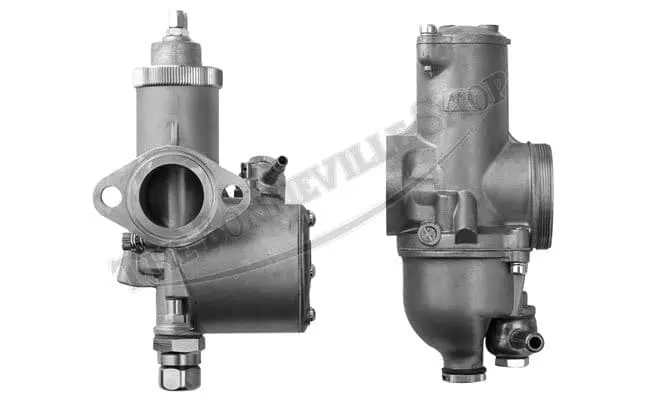
Carburation
To understand the basics of Triumph carb tuning, it is necessary to understand what carburetion is, what it does, and how it works. Carburetion is the mixture of fuel and air to form an explosive mixture for use in an internal combustion engine.
- Fuel is introduced to the carb via a float chamber, then entering the mixture chamber of a carburetor via metered circuits depending what stage of running the engine is currently experiencing.
- Air enters the carb mixture chamber through the throat.
- Air and fuel are combined in the mixture chamber and introduced to the engine via an intake manifold. When the mixture is then introduced into the engine’s combustion chamber, it is compressed and a spark (provided in a timed manner via the spark plug) ignites the mixture which in turn pushes back against the piston(s) to make the engine run.
- When the mixture is then introduced into the engine’s combustion chamber, it is compressed and a spark (provided in a timed manner via the spark plug) ignites the mixture which in turn pushes back against the piston(s) to make the engine run.
Engine’s require specific fuel/air mixtures to run properly and efficiently. The fuel/air mixture is pulled into the engine’s combustion chamber by the vacuum created when it is running. The faster an engine runs, the more fuel and air is necessary to keep it going.
Despite the speed an engine is turning, a consistent mixture is required to run correctly: too much fuel (rich condition) and an engine will feel sluggish, fuel efficiency will be extremely low, plugs will foul, and carbon will build up inside the combustion chamber. Too little fuel (lean condition), friction between the piston rings and cylinder will build up causing the engine to run hotter, performance is diminished, and ultimately pistons, cylinders valves and cylinder heads will become damaged and engine failure will occur.
Carburetion is a multi-step process to ensure that the correct amount of the fuel/air mixture enters the combustion chamber based on the needs of the engine. To ensure proper fuel/air mixtures are delivered to the engine, multiple carburetor steps are employed. Each must be adjusted correctly for smooth running across the range.
A quick note: Triumph Carb tuning is only one piece of the puzzle when tuning a motorcycle to run properly. Ignition timing, whether using a contact breaker (points) ignition, an electronic ignition, or a magneto, must be timed correctly to ensure spark is delivered to the compressed fuel mixture at the right time.
Additionally, valve timing and clearances must also be correct, and an engine must have enough compression, if any of these items are out of spec, the engine will not run correctly.
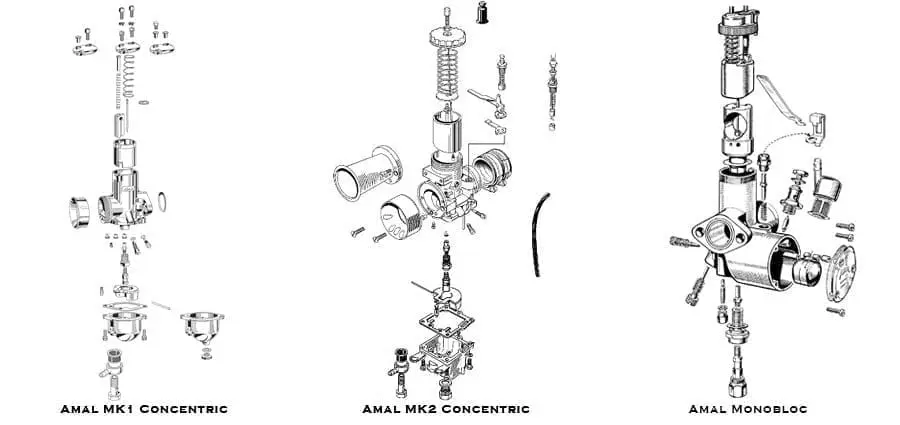
As noted previously, there are multiple carburetion steps to complete the range of running. For slow running at idle, the Pilot Circuit controls fuel. The pilot jet or bush controls the fuel level up to a 1/8 open throttle slide. From 1/8 to ¼ open throttle, the Throttle Valve (aka the slide) controls fuel, ¼ to ¾ open throttle is controlled by the throttle needle position and needle jet control the fuel, and for ¾ to wide open throttle (WOT), the fuel is delivered by the main jet. To run properly across the entire range of operation, all these systems must be properly tuned. Below are diagrams of the 3 most common Amal carbs.
Tuning Sequence
A good resource for Triumph carb tuning Amal Carburetors is the Amal Tuning Guide, which can be found on Amal’s website here https://amalcarb.co.uk/downloadfiles/amal/amal_tuning_guide.pdf. As detailed in the Triumph carb tuning guide, the sequence of carb tuning should be as follows:
- Main Jet (3/4 to wide open throttle)
- Pilot Jet (up to 1/8 throttle)
- Throttle Cut-Away (1/8 to ¼ throttle)
- Needle Jet / Needle Position (1/4 to ¾ throttle)
- Pilot Jet (fine tuning)
Main Jet
As indicated previously, the main jet enters the picture at ¾ to wide open throttle and is the first step in the Triumph carb tuning process. This is essentially the upper most limit to the amount of fuel entering the mixture chamber. The main jet is in the lower side of the carbs jet holder, opposite the needle jet and is replaceable in size increments of 10 for Amal carbs (ex. 160, 170, 180, etc.).
The larger the number, the richer the jet. In the case of Monobloc carbs, the jet holder is (and thus both the main and needle jets are) removable from the outside of the carb whereas for concentric carbs (both MK1 and MK2 types), the float bowl must be removed to access the jet holder. See diagrams above for main jet locations.
Pilot Jet
The pilot / idle circuit is the next step when Triumph carb tuning. The pilot circuit is metered by either a removable jet or fixed bush, adjusted by a pilot screw. Amal Monobloc carbs, the very early MK1 Concentrics (1967-68) and MK2 carbs all have removable pilot jets.
Sometime in 1968, Amal deleted the pilot jet instead pressing in a fixed size pilot bush as a cost saving measure. On bikes with a removable pilot jet, the jet can be replaced with a larger (richer) or smaller (leaner) size to further tune. On bikes with a fixed bush, the range provide by the pilot screw is the only adjustment possible without permanent modification to the carburetor. Pilot mixture can be richened (more fuel in the mixture) by screwing in the pilot screw. Mixture can be leaned (more air in the mixture) by screwing out the pilot screw.
As the pilot circuit is the smallest fuel circuit within a carb, it is usually the first place to look for faults. Fuel, especially modern ethanol fuel, can evaporate quite quickly leaving behind a varnish that blocks passages. As the pilot circuit passages are only .016” diameter, varnish or other debris can easily block them causing hard starting of a bike and the inability to hold an idle. Properly cleaning of the pilot circuit by removing and cleaning the pilot jets (when applicable), and further carb cleaning with a combination of carb cleaner, compressed air and use of a #78 drill bit through the carb passages should restore low speed running / idle to the motorcycle.
Step #3 with Triumph carb tuning is the throttle slide cutaway which controls the lower mid-range from 1/8 to ¼ throttle. When going from idle to moving, the throttle slide inside the carb is lifted by rotating the throttle on the handlebar, which pulls fuel and allows air into the mixture chamber. Throttle slide numbers refer to the depth of the cut-away at the base of the slide. The smaller the number, the richer the mixture.
Throttle slides are measured in half number increments: #2, #2.5, #3, #3.5, #4, etc. The smaller the number, the less air is introduced to the mixture, and most common slide number range for what we support is #3, #3.5 & #4. The pilot air screw also influences this circuit. If proper acceleration is not reachable by adjusting the pilot screw in this range, a smaller or larger cutaway slide should be fitted to suit.
Needle Jet and Needle Position
Next up we have the needle jet and needle position. The throttle needle is a metering device that moves up and down with the throttle slide. It is held in place with a circlip that locates into a groove and controls the mid-range (1/4 to ¾ throttle). The needle passes down through the needle jet to meter the amount of fuel allowed to pass through it.
When looking at the throttle needle, you’ll notice that the needle is tapered from thicker at the top to narrower at the bottom. Different tapers are available, and the correct taper is crucial for proper running for a given application. Needles can be moved up to down by locating the retention circlip into one of the grooves in the top of the needle.
To richen the mixture, raise the needle by locating the circlip into a lower groove. To lean the mixture, lower the needle by locating the circlip in a higher groove. An easy way to remember this is Lower to Lean, Raise to Richen. Needle jets are available in different sizes such as 105, 106, 107, etc. If lowering the needle jet fails to cure richness, a smaller needle jet should be fitted, and the needle raised to a higher position.
Likewise, if a lean midrange mixture exists and the needle is raised as high as possible, a larger needle jet should be fitted, and the needle dropped to a lower position. Needle jet wear is another common issue with poor running conditions when using older carbs. If needle jet wear is suspected, a new jet should be fitted.
Pilot Jet
Once all the circuits are tuned, you’ll want to return to the pilot circuit and fine tune idle.
Other Considerations When Triumph Carb Tuning
Float Adjustment
Carb Balancing / Syncing
Cold Starting and Choke Circuits
Effect of Altitude on Triumph Carb Tuning
Float adjustment: A carb float is the mechanism that allows fuel to enterm the carburetor. Used in conjunction with the float is a float needle, a device that locates into a seat in the carb body and is held up by a tab on the float. The float, as its name suggests, operates as a flotation device that allows fuel to enter up to a certain height, and pushes down on the needle to stop fuel from flowing in once the float chamber is flooded.
Float height adjustment is another aspect of carburetion that needs to be checked as an incorrectly set float can lead to a rich or lean mixture. To adjust float height, the tab that the float needles ride in need to be bent slightly. The original Amal floats (below left) are plastic and are not designed to be adjustable, while the modern “Stay-Up” floats (below right) feature metal tabs and that can be bent to adjust float level.

Carb Balancing / Syncing: For motorcycles with multiple carburetors, each carburetor will need to be tuned individually and, after each carb is individually tuned, carbs will need to be balanced (aka synced) to ensure each engine cylinder is appropriately supplied with fuel / air in relation to the other cylinders. A tool called a manometer which measures the amount of pressure acting on a column of fluid, gives a visual indication of carb sync in relation to each other. Carbs that are appropriately tuned and well balanced will lead to a strong running motorcycle.
Cold Starting and Choke Circuits: Chokes are a starting aid fitted to carburetors which help with starting a bike from cold. Chokes cut air to the carb mixing chamber, in turn flooding it with fuel causing an overly rich mixture. A rich mixture allows a cold engine to start more easily but leads to a poor overall running.
Once the bike nears operating temperature, the choke will need to be disabled. In addition to the choke circuit, a carb tickler is fitted to Amal Monobloc and MK1 concentric carbs. The tickler floods the float bowl with fuel, leading to a rich mixture. As the tickler accomplishes a similar goal as the choke (enrichen mixture), many users opt to delete chokes when using Amal carbs.
Effect of Altitude on Triumph Carb Tuning: Altitude affects carb tuning in that, at higher altitudes the air is thinner and thus the air/mixture needs to account for less air density. At higher altitudes, the mixture will become richer (excluding other variables such as air temp, humidity, etc.) and must be compensated for. Altitude doesn’t typically have much effect on Triumph carb tuning until around 3000’ above sea level.
To determine main jet adjustments for altitude, from 3000’ to 6000’ a main jet size reduction of 5% should be made (rounding up or down to nearest size). For altitudes above 6000’, a 4% reduction should be made per 3000’ rise. Above 4000’, typically dropping a size on the needle jet will lean the mixture properly. Needle position should also be considered, lowering the needle position when gaining altitude prior to swapping the needle jet to a smaller size.
Other variables that affect carburetion include air temperature, humidity, changes in inlet air filtration (air cleaners or the lack thereof), exhaust changes and air leaks around the carbs. Factors such as air temp and humidity typically do not lead to carburetion changes. Carbs should be tuned in the conditions they are most often ridden, and chokes or ticklers used to compensate for warm up. Anytime drastic changes to exhaust or air intake are made, such as removing mufflers, changing diameter or length of exhaust pipes, and removing or adding air cleaners, carburetion should be tuned for best running condition.
Riders will regularly complain of a rich or lean running carb and want to order new jets. Depending at what point the carb is running poorly will determine if re-jetting is the answer. The best way to help those customers is to understand at what point in the circuit the carb is performing poorly and point them in the right direction to rectify the poor running condition. Often, adjustments can be made at no cost to make carbs perform as they should rather than replacing parts
For additional reading on the subject of Amal Triumph Carb Tuning, refer to the Amal Tuning Guide, which is included with all Amal carbs we sell (& Wassell also includes their version)
https://amalcarb.co.uk/downloadfiles/amal/amal_tuning_guide.pdf
Here is an excellent article from Vintage Bike Magazine on Amal Triumph carb tuning
Triumph Carb Tuning FAQs
What should I check before tuning my Triumph’s carburetor?
Before adjusting the carburetor, check that ignition timing, valve timing, valve clearances, and engine compression are correct. Problems in these areas can cause poor running that carburetor adjustments alone will not fix. Carb tuning is one part of getting your Triumph running properly and is not a substitute for checking the engine’s overall condition.
How can I tell if my Triumph is running rich or lean?
A rich mixture contains too much fuel relative to air and can cause sluggish performance, poor fuel economy, fouled spark plugs, and carbon buildup. A lean mixture contains too little fuel and can cause excessive heat, reduced performance, and potentially serious engine damage. Identify the throttle position where the problem occurs before deciding which carburetor component to adjust.
Which carburetor component controls each throttle range?
Approximate operating ranges:
– Idle to 1/8 throttle: pilot circuit.
– 1/8 to 1/4 throttle: throttle slide cutaway.
– 1/4 to 3/4 throttle: needle position and needle jet.
– 3/4 to full throttle: main jet.
The circuits influence one another, so tuning involves checking how the engine runs throughout the throttle range rather than treating each adjustment in isolation.
What is the correct order for tuning an Amal carburetor?
The tuning sequence presented in the guide is main jet, pilot circuit, throttle slide cutaway, and then needle jet and needle position. Once those adjustments are complete, return to the pilot circuit to fine-tune the idle. This sequence addresses the carburetor’s different operating ranges systematically.
Does a larger Amal main jet make the mixture richer?
Yes. A higher-numbered Amal main jet supplies more fuel, making the mixture richer in the main jet’s operating range—approximately 3/4 to full throttle. However, a larger main jet is not a universal fix for poor running: an idle or midrange problem may involve a different circuit.
Why is my Triumph difficult to start or unable to hold an idle?
A blocked pilot circuit is one possible cause. Its small passages can become obstructed by debris or deposits left behind as fuel evaporates, affecting starting and low-speed running. Check the pilot circuit for contamination rather than assuming the carburetor needs different jets.
Which way do I turn the Amal pilot air screw to adjust the mixture?
On the Amal carburetors described in the guide, turning the pilot air screw inward richens the mixture, while turning it outward leans the mixture. This adjustment affects the pilot circuit and influences the transition into the lower throttle range. These directions should not be assumed to apply to every other carburetor design.
Does my Amal carburetor have a removable pilot jet?
That depends on the model and production period. The guide identifies Monoblocs, very early MK1 Concentrics from 1967–1968, and MK2 carburetors as having removable pilot jets. It notes that Amal began introducing a fixed pilot bush in MK1 Concentrics during 1968. Identify your carburetor’s actual configuration before ordering replacement pilot jets.
What does the number on an Amal throttle slide mean?
The number refers to the depth of the slide’s cutaway. A smaller-numbered cutaway produces a richer mixture, while a larger-numbered cutaway produces a leaner mixture in the lower-midrange, approximately 1/8 to 1/4 throttle. This makes slide selection relevant when addressing poor response as you open the throttle from idle.
How do I adjust the needle to richen or lean the midrange mixture?
Raise the needle to richen the mixture or lower it to lean the mixture. Moving the retaining clip into a lower groove raises the needle; moving the clip into a higher groove lowers it. Needle position primarily affects running between approximately 1/4 and 3/4 throttle.
When should I replace the needle jet instead of adjusting the needle?
A different needle jet may be needed when the needle’s adjustment range cannot correct the midrange mixture. The guide also identifies needle jet wear as a possible cause of poor running in older carburetors and recommends replacement when wear is suspected. Check both adjustment and component condition before selecting a replacement size.
Can an incorrect float level cause rich or lean running?
Yes. Float level affects the fuel level available to the carburetor’s metering circuits, so an incorrect setting can contribute to either a rich or lean mixture. The guide distinguishes original plastic Amal floats, which are not designed for adjustment, from modern Stay-Up floats with metal tabs that allow adjustment. Identify the float type before attempting to change its setting.
Do twin-carb Triumph motorcycles need carburetor balancing?
Yes. Each carburetor needs individual tuning, followed by balancing, also called synchronization, so the cylinders receive an appropriately matched supply of air and fuel. The guide describes using a manometer to compare the carburetors and assess their balance. Individual tuning and synchronization serve related but different purposes.
What is the difference between an Amal choke and a tickler?
Both help cold start by enriching the mixture, but they work differently. A choke restricts incoming air, while a tickler floods the float bowl with additional fuel. The guide identifies ticklers on Amal Monobloc and Mk1 Concentric carburetors and explains that the choke should be disengaged as the engine approaches operating temperature.
Will riding at higher altitude affect my Triumph’s carburetor tuning?
Yes. Higher-altitude air is less dense, so an unchanged carburetor setup tends to run richer. The guide discusses leaner jetting and needle adjustments for higher elevations, with altitude becoming a more significant consideration around 3,000 feet above sea level. Treat its altitude guidance as a starting point rather than a guaranteed setting for every motorcycle and riding condition.
Do I need to rejet after changing my exhaust or air filter?
Significant intake or exhaust changes can require carburetor retuning. The guide specifically mentions adding or removing air cleaners and changing exhaust configuration. However, retuning does not always mean buying new jets: the affected throttle range may point to an adjustment of the pilot screw or needle position instead.